Vertigo & Dizziness
Finally Understand Why You Feel Unsteady — And What Can Be Done to Fix It
Dizziness and vertigo are among the most common — and most frustrating — neurological symptoms.
They can appear suddenly or gradually, and they often leave people feeling:
-
Off balance
-
Motion-sensitive
-
Foggy or “detached”
-
Unsteady while walking
-
Overwhelmed in busy environments
-
Afraid to drive
-
Worried something serious is wrong
If this sounds familiar, you’re not alone.
And most importantly: you’re not imagining it.
These symptoms are real, and they always have a neurological cause — even if your tests came back “normal.”
Why Most Vertigo / Dizziness Patients Struggle to Get Answers
Dizziness is often a functional problem, not a structural one.
It’s caused by communication errors between:
-
Your vestibular system (balance organs)
-
Your eyes (tracking, gaze stability, visual motion processing)
-
Your cervical spine (neck proprioception)
-
Your brainstem & cerebellum (coordination and timing)
-
Your autonomic system (blood pressure, heart rate, breathing)
-
Your environment (motion, visual complexity, sensory input)
When any of these systems fall out of sync, your brain can no longer accurately interpret movement or position.
The result?
Dizziness, vertigo, imbalance, motion sensitivity, and brain-fog.
This is exactly what we specialize in.
Traditional care often misses the root cause of dizziness because it focuses on structure:
-
CT / MRI looks for major abnormalities
-
ENT checks the inner ear
-
Neurology looks for red flags
-
PT screens balance
-
Chiropractic looks at the neck
These are valuable — but they leave out the most important part:

Non-Medication Treatment for Neuropathy & Nerve Pain Is Available in Carmel, IN
At Nexus Neuro, we treat the full spectrum of dizziness presentations:
Benign Paroxysmal Positional Vertigo (BPPV)
Spinning sensations triggered by head movements; often missed or misdiagnosed.
Vestibular Neuritis / Labyrinthitis
Sudden severe vertigo followed by lingering imbalance or motion sensitivity.
Chronic Dizziness / Rocking Sensation
Lingering imbalance long after the original episode.
Motion Sensitivity
Symptoms in cars, stores, crowds, or while scrolling.
“Floating,” “Bobbling,” or “Swaying” sensations
Often from vestibular-visual mismatch.
Post-Concussion Dizziness
Cervical, vestibular, and visual pathways disrupted simultaneously.
PPPD (Persistent Postural-Perceptual Dizziness)
Dizziness triggered by motion, visual patterns, or busy environments.
“My head feels weird / foggy / off.”
Sensory integration issues — extremely common.
Whatever the label, the root cause is always neurological, and always identifiable with proper testing.
How We Diagnose Vertigo & Dizziness at Nexus Neuro
This is where we excel — and where most clinics fall short.
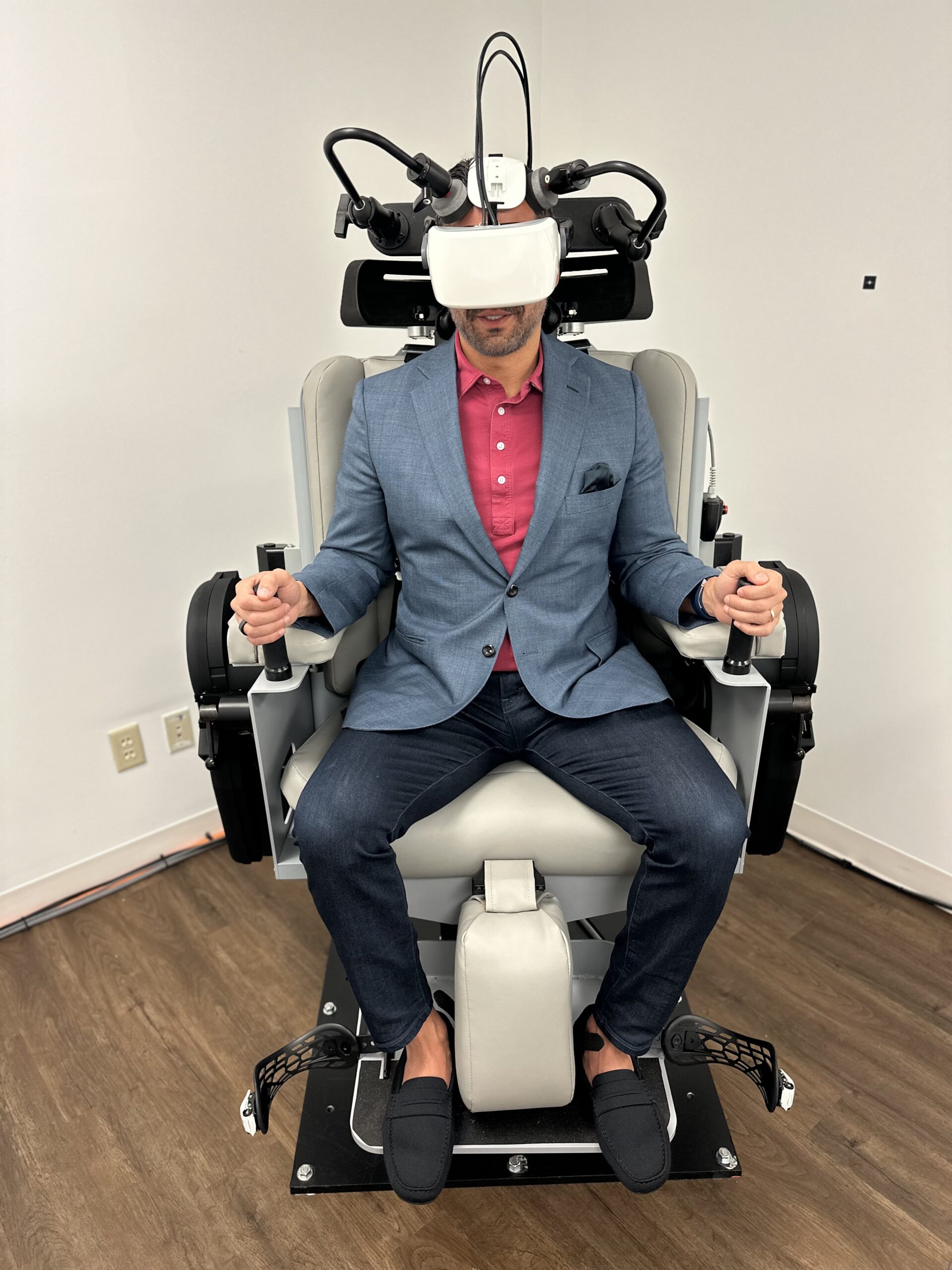
We use the NeuroAI platform combined with DX200 VOG/VNG ocular-motor analysis to examine:
Gaze stability
Smooth pursuits
Saccades
Vestibulo-ocular reflex (VOR)
Optokinetics
Head impulse responses
Spatial disorientation patterns
Visual motion intolerance
Vestibular catch-up saccades
Cervical-vestibular contributions
Autonomic involvement
This technology reveals abnormalities in milliseconds, something that cannot be seen with the naked eye — and cannot be found on MRI or CT scans.
In other words: we identify what everyone else misses.
Why Vertigo Happens — Explained Simply
Dizziness isn’t random.
It happens when your brain receives conflicting signals about where your body is in space.
For example:
-
Your inner ear says you're moving
-
Your eyes say you're still
-
Your neck signals don’t match either one
-
Your brainstem can’t integrate it
-
Your autonomic system overreacts
Your nervous system chooses the safest response:
❗ “Shut it down” — dizziness, fog, nausea, imbalance.
But with the right testing, we can identify which system is out of sync, and more importantly, how to fix it.
How We Treat Vertigo & Dizziness
Once your diagnostic data reveals the source of your symptoms, we design an individualized neurological rehabilitation plan, which may include:
Vestibular Rehab (VOR Training)
Strengthening the reflex that stabilizes your world while you move.
Oculomotor Training
Improving tracking, focus, and visual-vestibular coordination.
Cervical Proprioceptive Rehab
Correcting neck-driven dizziness and sensory mismatch.
Balance & Postural Integration
Re-training cerebellar pathways for stability and confidence.
Visual Motion Desensitization
Rebuilding tolerance to screens, driving, crowds, and movement.
Autonomic Regulation Therapy
Stabilizing heart rate, breathing, and blood pressure responses during triggers.
BPPV Canalith Repositioning
Performed with precision diagnostics to ensure proper resolution.
Neuromodulation & Restorative Therapies
SoftWave, red-light, and sensory-based neuro-activation to enhance adaptation.
Every plan is:
Data-driven
Customized
Progressively built
Adjusted based on objective results
This is not generic PT or “dizzy exercises.”
This is precision vestibular, visual, cervical, and autonomic rehab.
Signs You’re a Good Candidate for Our Program
You may benefit from our evaluation if you:
-
Feel unsteady or off balance
-
Have dizziness that comes and goes
-
Get worse in visual environments
-
Feel “off” when scrolling or watching movement
-
Can’t tolerate quick head turns
-
Have headaches or pressure with dizziness
-
Experience brain-fog with balance issues
-
Had a concussion with lingering symptoms
-
Are avoiding driving
-
Feel dizzy when lying down or rolling over
-
Have dizziness with neck pain
-
Feel “not like yourself”
If your dizziness hasn’t gone away, there is a reason — and we can find it.